Showing posts with label Hall of Truth. Show all posts

美麗的背後

漫漫的黃沙,淹沒了他和她曾經的城市。
但是,她卻穿越時間,穿越阻隔,來到我們的面前。我們驚奇,我們讚嘆,我們着迷。 千千萬萬的人之為一睹她的容顔,擠滿了整個博物館。1年以前,我就曾經站在她的對面,深深駐足,看着,望着,想着。。。她的平靜,她的安詳,她的凝望,讓我深深的着迷。
她真的很美,每個人都這麽想,每個人都被她所迷惑,人們驚異于世上竟然有如此美人。而且,她的美麗甚至戰勝了時間。
她已經永恒。
多麽令人羡慕的字眼,永恒,多少人傾其一生追求,但是她卻擁有了。
但是,美麗的背後呢?那是什麽?對權力的追求,對頂點的嚮往。瘋狂。

儅人們追溯她的歷史時,發現她的不平凡,獨一無二。她曾經擁有多麽不平凡的一生阿。她不光擁有傲世的美貌, 也擁有驚人的能力。嫁給法老,掀起革命,建造城市,樹立雕像,她是一位神。她相信自己可以成爲神,代替所有埃及的眾神,她傾覆了一個國家的力量,來打成這個願望。

失敗了。
歷史學傢說。
失敗了嗎?
沒有,
她成功了。
而她的丈夫,
也是。

儅他們兩個望向我們的時候,
我想他們是笑着的,
驕傲的笑着。

Dreaming back to Egypt

昨晚,又夢到了埃及,
藍色的尼羅河是那麽的耀眼。
幸福,因爲有了你!
今天是個好天氣,
明媚的陽光,
陣陣的微風,
沒有嘈雜聲,好安靜。
突然我覺得,我好想念埃及的下午。
一樣的陽光,
一樣的微風,
一樣的安靜,
不同的是身邊有一條大河,
遠處是片片黃沙,
我真的好想念你啊,
我的埃及!
什麽時候我可以再次踏上這片土地?
魂牽夢繞,
暗自惆悵。
我想你,
埃及!

"Art of Ancient Egypt and Mesopotamia"

都說中文書裏面沒有埃及學得好書,我卻有點將信將疑。今天我可以下定論了:是的,沒有好書。(這裡的好我是指書中内容吸引讀者,令他們愛不釋手,讀到廢寢忘食。)不是論述不夠深入,就是資料千篇一律。<古代埃及和美索佈達米亞美術>看上去好專業的一個書名,其實也不過如此,雖然他自稱是中國人為世界美術著述的第一次嘗試,但是我可以說這本書和世界上其他國家,特別是歐洲編撰的書籍還有一段距離。
先說這本書超級政治化的前言,就給人一個差勁的第一印象。一本論述藝術的書籍,竟然需要這麽政治化的前言。我個人認爲,這樣的書的前言因該講述中國學者對藝術的理解,而不是出版這本書的政治意義。文中提到:不少歐美學者編著的世界美術史...受到歐洲中心論和西方中心論的影響,對亞洲特別是中國藝術史的面貌反映的很不充分, 對俄國和東歐藝術也存有偏見,不予介紹或一筆帶過。還有...算啦...不寫這種帶有批判性的文字了。
撇開前言,總體來説這本書還可以算是合格的美術介紹書籍。其中對古埃及的藝術的描寫也不乏精彩的部分,只不夠要是在具體深入一點,那麽會在吸引讀者方面更上一層樓的。不過這也不能改中國學者,畢竟埃及學在中國並不發達,學者不多,資料也不豐富。
做一點書摘:
1,埃及建築中的柱式式樣優美,變化很多,除了個別的特殊式樣之外,常見的有8种式樣:前多利亞式:與希臘多利亞柱式相似,但時間早于希臘,商博良認爲這種樣式是希臘多利亞式的先驅,顧命名為前多利亞式。哈托爾式:柱頭刻有哈托爾神的頭像,柱身為圓彫,刻有一束花莖。這種樣式多見於中王國時期。棕櫚式:模仿棕櫚的一柱式,柱頭有8片棕櫚葉合成的一個圓形,葉的下端饒有5個環帶。柱身特別長,頂端有扁方頂板,下游柱基。蓮花式:柱頭用一束含苞未放的蓮花作爲裝飾,這種蓮花是埃及地方特有的睡蓮。柱身 用4到6根花莖為一束,莖的上部用5條環帶束縛着。這種柱式流行于古王朝第5王朝到新王朝之間。以後逐漸消失。後來的托勒米王朝又有出現。紙莎草式:很接近蓮花式。柱身用16支紙莎草為一束,柱身是含苞待放的紙莎草。這一樣式創立于古王朝的第5王朝時期,盛行于新王朝的阿梅諾菲斯時代。 直到古埃及末期,這個樣式經久不衰。紙莎草變體式:紙莎草式的簡單化。新王朝第19王朝以後才出現。主體全身完全模仿紙莎草式,不過柱身改爲一根莖。柱身表面光滑,飾以象形文字和圖形。比例粗壯,敦實厚重使這一樣式的特點。開花的紙莎草式:柱頭是盛開的紙莎草花, 柱頭的下端有三角形裝飾。混合式:創立于較晚的托勒米王朝。柱頭像是許多紙莎草花束在一起,極爲華麗。
2,中王國時期的經濟,文化繁榮,但社會關係顯然比古王國要複雜得多。在經歷了幾百年動亂之後,人們不再相信有永恒的社會秩序,不再相信天下獨尊的法老地位不可動搖。在古王國只有法老被指定為神, 而臣民的來世也依靠他的恩惠。 而在中王國,州的統治者也享有神的權利,這種權利進一步放鬆,甚至連葬禮的祭司也可享受神的禮遇。 神權的鬆懈反映在藝術上,是不再有古王國時代卓越宏偉的建築和雕像。法老的陵墓也沒有過去那樣高大堂皇, 大多是塼砌的小型金字塔,只是表面上包一層石灰岩,相反, 貴族們的墳墓其華麗程度似可與國王陵墓相媲美。
3,(阿肯那頓)的臉部是沉思的,十分精致的甚至是病態的容貌,具有令人不安的神祕感。 對於這一點,它比早期和晚期的埃及法老那毫無表情,呆板的假面具更富有感染力,埃及法老的面具總是充滿着宗教氣息, 於世俗世界是遠離隔絕的。...阿肯那頓的雕像,表現了他作爲一個改革傢的面容:臉部清瘦,嘴的綫條柔和,眼神裏流露出夢幻般的迷離,表現出一種沉湎于冥思苦想的哲學家的精神氣質和神經質,顯示出一個激進改革傢的急躁和狂熱的性格。
4,奈菲爾提提雕像:從她的典雅姿態中散發出理想主義的美和寫實主義的氣息。她高傲的台着頭,低垂着眼簾, 肉色皮膚繪飾得柔軟而平滑。這件肖像傑作具有完美的形式感和韻律美,高高升起的皇冠和細長的頭頸構成優美的綫條,微揚的頭部和專著的眼神仿佛表現皇后剛巧停頓一下,注視着什麽。

Reading Notes from the Book: Women in Ancient Egypt(00)

All the info was gathered from this wonderful book: Women in Ancient Egypt by Gay Robins.
I made these info into a pic and put it on my forum. And I translated some main info into Chinese, in this way, it will be easy for people who are not familiar
with Eng to read and understand.


Today, I finally finished my wonderful book by Joyce. I have read many books by her and already familiar with her writting tyle.
This is the second part of my reading notes.

1,from the section of Ramsses the Hushand, I know that the role of queen in ancient Egypt was quite different from that in Hatti. In Hatti there can be only one queen who held the power. So that means that one queen must wait for the death of her mother-queen-in-law. Until that moment came, she can not practice her full power. But the situation was totally different in ancient Egypt, during New Kingdom. The power of queen seemed to be divided, so put it this way, the role of queen mother was ore political, she helped her son to govern the country if in need. However the queen of the Pharaoh was more ceremonial and religious. She played more in ritual ceremonies than in political cases. But there was no absolute rule for the queens to share power.
2, during the life time of Ramsses the Great, he had many queens, principle queens I meant. One was Nefetari who is until now staying the shadow. No scholar can tell who actually she was, she never claimed to be the daughter of King, so that means she can not be direct royal birth. Some people suspected that she was a small daughter of Ay. Maybe... Another queen was called Iset-Neferet who was also remained mysterious to us. But one interesting thing was that those children given birth by these two queens were equal. Usually, the children from Nefertari should be the first ranking then maybe those from Iset-Neferet. Author also expressed in this book the doubt of whether or not Ramsses did love Nefertari. Legend Held that Ramsses loved her consort Nefertari very much and he built her the most breathtaking temple and tomb. Yes, I believe so, Ramsses did love his wife! Author argued that the reason of building such beautiful temple to his wife was to promot his own image, which I am not agreed with! But after reading this book I have now in mind one doubt that maybe Ramsses loved two women at the same time, Nefertari and Iset-Neferet.
3,last point is about those princesses. In ancient Egypt those royal princesses were not allowed to marry low-ranking people or outside their royal family,even into foreign lands, so the only choices left for their husband were their father, brother and half-brother...
1, the five names of Ramsses the Great:
the Horus King: Strong Bull, Beloved of Right, Truth
He of the two Ladies: Protector of Egypt who curbs the foreign lands
The Golden Horus: Rich in Years, Great in Victories
King of Upper and Lower Egypt: Usermaatre
Son of Re: Ramsses the Second, Beloved of Amun
Only the latter two names will be written in cartouche

2, the author mentioned that “arrivistes with a strong urge to justify their hold on Egyptian throne, constantly looked to the precedents”, which I am not comfortable with. The Egyptian throne was past to Ramsses the First from Horrenheb legally. Although Ramsses the First was no royal birth, the succession was totally according to the will of Horrenheb. So I think the reason of addressing precedents aimed at erasing the memories of Akenaton. By directly referring deeds done by great Pharaohs before, Ramesside Kings were trying to re-establish the glory and cutting the Akenaton out of records.

3, as a political and religious role, Pharaoh, theoretically, was not considered as an individual, but a continuality of protector and nation leader whose image remained for most of time similar. But Ramsses seemed regarded individuality was important too, as to promote his greatness, he used every chance to achieve this goal. He wanted his people but only to remember him as a great Pharaoh but also as an unsurpassable “He”.

4, in ancient Egypt there was actually no term for “religion”, and the meaning of “ancient Egyptian religion” can not be understood by the modern term “religion”. In ancient times people treated their Gods as an interpretation of the world, so say the term” science” will be more close to the meaning of ancient Egyptian religion. As the chief priest, Pharaoh should supposedly take the role more administratively than religiously. They maintained the order of world by making sure that those ceremonies would be carried out, rather than being a religious prayer all the time. What did Akenaton do wrong was that he took the role wrong; he was practically a real religious priest who discarded all his administrative duties. Or he misunderstood the role of Pharaoh? By being a religious person, he was actually denied his entire kingship. Say, maybe he was really a visionary who understood no other but his religion?


Several thousand years ago, Herodotus asked a priest from an ancient Egyptian temple about the achievements of Egyptian civilization, he was so curious about what made this civilization so powerful and unique. The priest gave an answer which would be taken as an unbreakable rule to understand ancient Egypt. He said: Egypt is a gift of the Nile. Indeed, it is true! No other river on the earth can be compared to the Nile, whose magic power gave rise to a great civilization. The influence of the Nile coveres almost every aspect which is vital for the birth and the growth of a civilization, but in this short article I will only focus on one aspect: the influence of the Nile on the intellectual world of ancient Egyptians and try to give an answer to the question of how and why the Nile gave such an influence.

Nile, the longest river on the earth, flows from the heart of African continent and forces its way towards north. When it reaches Egypt, a piece of land located in desert and controlled by dry weathers, Nile creates a breathtaking view which will capture everyone’s eyes: between two deserts flows a mighty river, which brings life and greenness.

The miracle the Nile created was astonishing. With the flow of Nile there would be trees alone the banks of the river, there would be enough humidity and wind to bring down the heat, there would be plenty of water for cultivation. Following that living animals would settle there, and people would prosper from the blessing of Nile. What is more, since the dawn of history this river has performed another miracle. The annul flood brought numerous fertile black soil, which allowed ancient Egyptians to plant their crops without constant care. What was why the ancient Egyptians called their land Kemet( Black Land). The river impressed the ancient Egyptians so deeply that they treated this river as a God named Hapi, and they even wrote hymns to praise him.

“they tremble,

they who see Hapi when he beats;

but the meadows smile,

the banks blossom,

the offerings of the gods come down;

men do homage,

the hearts of the gods are lifted up…” (A.Moret 1996:30)

But the greatness of Nile was not only the blessing of material life, but also on the mentality of ancient Egyptians. The river shaped the world view of ancient Egyptians and also many other aspects. And those influences were so strong that it would become a marker of Egyptian mentality.

In the concept of ancient Egyptians, the world, which was brought by gods, was perfectly balanced.

Ancient Egyptians relied on the Nile for about 3500 years, but they never solved the problem of the origin of this river. To them this question was involved with supernatural power. They believed that the origin of this river was from underground. The gods who lived there controlled the coming of flood every year. So in the eyes of ancient Egyptians, this river was no ordinary one and it may also participated in the creation of the world. Before the earth came into being, only primordial water, which was called Nun by Egyptians, existed in the universe, there was no land, no living things. Nothing existed but water. Later a piece of land, which the Egyptians believed to be the land of Egypt, rose from the water. And it was on this very land stood the creation God. The mighty one single-handedly brought everything into existence. From this simple and thoughtful myth, we can clearly see how deep the print of Nile on Egyptians’ mentality.

The land of Egypt was the gift from the mighty God and this God also brought perfect balance and order into the land. But these balance and order were constantly threatened by chaos. This was a fundamental concept of ancient Egyptians. And we can easily find clues in Nile and the environment Nile created. The Egyptians lived in a paradise created by Nile. They saw order and balance in this heaven. The season was divided by the rhythm of Nile, the flood was coming every year, the crops grew healthily, the birds were singing, the trees stood straightly on the banks, the people worked hard on their land, the children played around the houses…… It was a picture of peace and prosperity. However, this balance was threatened. If one year the Nile failed in flooding, there would be nothing but famine and death, and the deserts would invade the lands. And the Egyptians had already seen an example during the Old Kingdom (2650BC-2134BC).

Besides the fundamental concept of balance and order, another characteristic in Egyptians’ mentality was introversion. Egyptians treated the environment created by Nile as a shelter, which could help them get rid of unknowable things and uncertainty came from outside. To them the world outside was unexplainable, and the place they own was the best with order and civilization, it was created by God. As a result the Egyptians tended to be inner and conventional. They did not have so many curiosities towards the world outside.

The Nile shaped the world view of the ancients. At the same time, Nile inspired the Egyptians even more.

The places influenced by Nile were marked the prints of life. In contrast to life, the places in Egypt without the influence of Nile were filled with death and harshness. Ancient Egyptians must have been impressed by this scene a lot. And they were the earliest people to concern the problem of life and dearth. But they again got inspirations from their mother river. People in Egypt saw the rising water of Nile in several weeks, transforming the land into a watery world, then life began after the inundation. The miracle performed every summer left a message to the Egyptians that life could come back; life would finally overcome the shadow of dearth. Slowly they developed a sophisticated belief system and religion, which would give inspirations to later religions.

Nile, the mother of ancient Egyptians, did help the Egyptians to understand the world. But here comes another question: why was the influence of Nile so overwhelming?

I think there are two reasons. First of all, due to the isolated position of Egypt, other important elements are blocked. Most of the scholars believe that Egypt is surrounded by natural barriers. To the north is the Mediterranean Sea, to the south are the Nile cataracts. On eastern and western side are two deserts. So, at some level we can say that Egypt is protected by nature, people would focus more on local elements than from outside.

Secondly, I think, people more likely tend to be inspired by element that is beneficial. Nile is the only lifeline in Egypt, so it makes total sense that Egyptians got the most inspirations from the Nile.

The ancient Egyptians created a colorful intellectual world which would astonish later people. While the Nile contributed a lot to this great achievement. It is a river that shaped history, it is a river that gave birth to ancient Egypt, and it is a river that taught the Egyptians to make history. I would like to end this article by quoting a hymn of the Nile.

“Hail to thee, O Nile! Who manifests thyself over this land, and comes to give life to Egypt! Mysterious is thy issuing forth from the darkness, on this day whereon it is celebrated! Watering the orchards created by Re (Sun God), to cause all the cattle to live, you give the earth to drink, inexhaustible one!”¹

Quotations:

1, Hymn to the Nile

http://www.reshafim.org.il/ad/egypt/texts/hymn_to_the_nile.htm

on 10. Nov. 2007

References:

1, A.Moret (1996): the Nile and Egyptian Civilization

2, James Henry Breasted (1986): Development of Religion and Thought in Ancient Egypt

Why is She so Special, I am so Jealous!

Why is she so special?! I wanna be like her, and experience the same like she did!
She was really blessed by Egyptian Gods.
She escaped from death, then fell in love with ancient Egypt.
She claimed herself as a priestess of Isis, she studied under an Egyptologist,
She saw the reappearance of Sety the First, she talked to him.
She was loved by a Great Pharaoh, she believed ancient Egyptian religion which I am too.
She worked in Egypt and also lived there,
She could enter all the temples without limitation,
She could sleep with Sety and my beloved Ramsses.
She could drink wine with them.
She could die in Abydos!

I am so jealous about her life, and her experiences, I wish I could have the same, but I have been already lucky enough, to be blesses by Egyptian Gods and Goddess! Thank Amun-Re!!

the Search for Omm Sety-Sety was wandering as Akh?


According to the secret diary of Omm Sety, one night of 1972, the long gone Sety was coming to Omm Sety and he lay down besides her, and put his arms around her. They talked something unbelievable. Omm Sety invited Sety to tell the near death experience. And Sety did, he said: the feeling was wonderful, just as you feel your Akh is released from your body. But one's thoughts and feelings remain the same." Sety saw his surroundings: his lileless body, his son Ramsses, and his daughter was crying bitterly. Then he went to the judgement hall which was in the religion and myth of ancient Egypt. At last he told the story of searching for the reincarnation of his beloved girl( now Omm Sety), and he crossed the time and saw many strange places and things.
Is this true that a spirit from ancient times really could go beyond the time and come to us? Is it true that all the myth and Egyptian religion state the truth of life and death? Is that true that Omm Sety was really a reincarnation? Is her story true?
There are so many "is that", I wish Omm Sety could personally tell me her experience and maybe she and Sety, I wish she could be alive now.
I have to continue the book, I am sure I will have more discoveries, and more surprises.

Remind Me Again

Remind me again---
together we trace our strange journey,
find each other,
come on laughing.
Some time we will cross where life ends.
We'll both look back as far as forever,
that first day.
I will touch you---
a new world then.
Stars will come a different way.
We will both end.
We will both begin.
Remind me again.

Enternal Love of Sety 1st

Finally I got this excellent book which is about the life of an extraordinary woman who believed in herself that she was a priestess of Isis in ancient Egypt.
And about this women:
(from one of my blog article)

"Dorothy Eady who was known as Omm Sety: the Mother of Sety. I remember that the first time I came across this lady was during my reading of an ancient Egyptian book. But few years later, I totally forgot her. With some unknown reasons, I suddenly wanna know her now. So I checked the internet for some info about her, because the memory about her in me was too blur. To my great surprise, there is little info about her. I tried my best, the only info I got was a summery.

She was born to an ordinary Irish family and she seemed, too, ordinary. But after an accident in her childhood: falling off something...her life was completely changed, after she woke up, she claimed she wanna go home, and that was Egypt. More surprisingly was that she told people that she was the reincarnation of an ancient Egyptian priestess of Isis during the reign of Seti 1st.What's more, in her previous life, she did have physical relationship with Pharaoh Seti.
When she grew up, she went to Egypt and married an Egyptian man and produced a son who was named after the Pharaoh Seti 1st. That is why she was called Omm Sety. Omm Sety had extremely rich knowledge about the history during 19th Dynasty, and Seti. Her knowledge astonished many Egyptologists, in some cases, she could accurately pointed out the location of the garden in the Temple of Isis, where now only ruins left. And she could stated clearly the process of rituals in ancient times. Omm was counted as a very convincing example of reincarnation. Here is a link about her: Point me "

During my reading of this book, I found something unbelievable jet convincing. Some people, most of the people are doubtful of the fact of reincarnation, but yet, there was a case of Omm Sety, she did claimed the existence of reincarnation and also she was amazing. So maybe there are some magic powers that are unknown to us.

Today I read some beautiful words about the story between Pharaoh Sety and Omm Sety.
Once upon a time there was a sacred place in ancient Egypt which was called Abydos. And there was a peerless temple built by Sety dedicated to the great God Osiris.And Omm Sety was a priestess of Goddess Isis. Besides the temple there was a huge garden with a lotus pool. Alone the pool were planted many trees and flowers. One day when Bentreshyt( the previous life of Omm Sety) was picking flowers in the garden, Pharaoh was just coming by and saw Omm Sety. She was beautiful with blond hair and blue eyes, her blood was not pure Egyptian. When she made a clumsy gesture to show her respect to Pharaoh, Sety laughed and called her over to him.
This was so beautiful and romantic, I always imagined how it would be when Ramsses smiled, was he handsome? Was he manly? Omm Sety said that Sety was extremely handsome and attractive, even in his fifties, now I am sure about my beloved Ramsses, it is so nice to know!
Then things went smoothly, Pharaoh fell in love with with girl, and the girl too attracted by Pharaoh. But in ancient Egypt, priestess was not allowed to be touched by anyone, even the Pharaoh, in order to save Sety from breaking to law, Omm Sety committed suicide. When Sety heard about the news, he siad: I will never forget you!" And he did!

3000 years later...According to Omm Sety's diary,Sety came to her when she returned to Egypt in 19ths. This is unbelievable, but...yet believable. Sety held her in his arms and talked with her about his near death experience and the journey through death.

After reading I was wondering if the religion of ancient Egypt did involved some hidden power? How could this happen? Sety came back to 19th century? And found the reincarnation of Omm Sety??

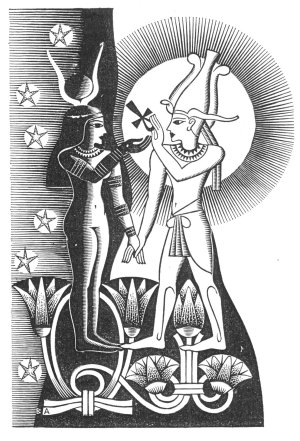
Eternal Love-Osiris and Isis

Sing we Osiris dead,
Lament the fallen head:
The light has left the world, the world is gray.
Athwart the atarry skies,
The web of darkness flies,
And Isis weeps Osiris passed away.
Your tears, ye stars, ye fires, ye rivers, shed,
weep, childern of the Nile, weep for your lord is dead!

Softly we tread, our measured footsteps falling
within the sanctuary sevenfold;
Soft on the dead that liveth are we calling:
"Return, Osiris, from thy Kingdom cold!
Return to them that worship thee cold."

Within the court divine
The sevenfold sacred shrine
We pass, while echoes of the temple walls
Repeat the long lament
the sound of sorrow sent
far up within the imperishable halls,
Where, each in other's arms. the sisters weep,
Isis and Nephthys, o'er his unwaking sleep.

Softly we tread, our measured footsteps falling
within the sanctuary sevenfold;
Soft on the dead that liveth are we calling:
"Return, Osiris, from thy Kingdom cold!
Return to them that worship thee cold."

O dweller in the west,
Lover and lordliest,
Thy love, thy sister Isis, calls thee home!
come from thy chamber dun,
thou master of the sun,
Thy shadowy chamber far below the foam!
With weary wings and spent
through all the fragment,
through all the horror-haunted ways of hell,
I seek thee near and far, from star to wanderintg star,
Free with the dead that in Amenti dwell.
I search the height, the deep, the lands, the skies,
Rise from the dead and live, our lord Osiris, rise!

Egyptian Cinderella

The Egyptian version of Cinderella. In this version her name is Rhodopis (ra-doh-pes). Considered one of the oldest versions of the Cinderella story. It was first recorded by the Roman historian Strabo in the first century BC. This version is based on fact and fiction. Fact: there was a Greek slave girl named Rhodopis who married a Pharaoh Amasis (Dynasty XXVI, 570-536 BC) and became his queen. A fellow slave, Aesop, told her many stories. In this version the slipper is not golden but rose-colored.
"Long ago in the land of Egypt were the green water of the Nile River flows into the blue water of the Mediterranean Sea lived a young maiden named Rhodopis." Rhodopis was born in Greece but was kidnapped by pirates and carried down into Egypt where she was sold into slavery. Her owner turned out to be a kind old man who spent most of his time under a tree sleeping. Because of this he never saw how the other girls in the house, all servant girls, taunted and teased Rhodopis. They teased her because she looked differently from them. Their hair was straight and black while hers was golden and curly. They had brown eyes and she had green. Their skin had the glow of copper, but Rhodopis had pale skin that burned easily in the sun causing them to call her Rosy Rhodopis. They also made her work hard shouting at her all day, "Go to the river and wash the clothes," "Mend my robe," "Chase the geese from the garden,: "Bake the bread." Now Rhodopis had no friends only the animals. She had trained the birds to eat from her hand, a monkey to sit on her shoulder, and the old hippopotamus would slide up on the bank out of the mud to be closer to her. At the end of the day if she wasn't too tired she would go down to the river to be with her animal friends and if she had any energy left from the hard day's work she would dance and sing for them. One evening as she was dancing, twirling around lighter than air with her feet barely touching the ground, the old man woke from his sleep and watched as she danced. He admired her dancingt and felt that one so talented should not be without shoes. He ordered her a special pair of slippers. The shoes were gilded with rose-red gold and the soles were leather. Now the servant girls really disliked her for they were jealous of her beautiful slippers. Word arrived that the Pharaoh was holding court in Memphis and all in the kingdom were invited. Oh how Rhodopis wanted to go with the servant girls. For she knew there would be dancing, singing, and lots of wonderful food. As the servant girls prepared to leave in their finest clothes they turned to Rhodopis and gave her more chores to do before they returned. They poled their raft away leaving a sad Rhodopis on the bank. As she began to wash the clothes in the river she sang a sad little song--"wash the linen, weed the garden, grind the grain." The hippopotamus grew tired of this little song and splashed back into the river. The splashing of the water wet Rhodopis's slippers. She quickly grabbed them up, wiped it off and placed them in the sun to dry. As she was continuing with her chores the sky darkened and as she looked up she saw a falcon sweep down, snatch one of her slippers, and fly away. Rhodopis was in awe for she knew it was the god Horus who had taken her shoe. Rhodopis now with only one slipper put it away in her tunic. Now the Pharaoh, Amasis, Pharaoh of upper and lower Egypt was sitting on his throne looking out over the people and feeling very bored. He much preferred to be riding across the desert in his chariot. Suddenly the falcon swooped down and dropped the rose-red golden slipper in his lap. Surprised but knowing this was a sign from the god Horus he sent out a decree that all maidens in Egypt must try on the slipper, and the owner of the slipper would be his queen. By the time the servant girls arrived the celebrations had ended and the Pharaoh had left by chariot in search of the owner of the golden slipper. After searching on land and not finding the owner he called for his barge and began to travel the Nile pulling into every landing so maidens could try on the slipper. As the barge rounded the bend in front of the home of Rhodopis all heard the sounds of the gong, the trumpets blaring, and saw the purple silk sails. The servant girls ran to the landing to try on the shoe while Rhodopis hid in the rushes. When the servant girls saw the shoe they recognized it as Rhodopis's slipper but they said nothing and still tried to force their feet into the slipper. The Pharaoh spied Rhodopis hiding in the rushes and asked her to try on the slipper. She slid her tiny foot into the slipper and then pulled the other from her tunic. The Pharaoh pronounced that she would be his queen. The servant girls cried out that she was a slave and not even Egyptian. The Pharaoh responded with "She is the most Egyptian of all...for her eyes are as green as the Nile, her fair as feathery as papyrus, and her skin the pink of a lotus flower."


My Translation:
古埃及版本的灰姑娘故事。在這個版本中她的名字叫做儸德菲斯(拉-得-佩斯)Rhodopis (ra-doh-pes)。這個故事可以被認爲是最古老的灰姑娘故事。它最早被一位1世紀時代的羅馬歷史學傢Strabo所記錄。這個故事是建立在事實和虛構之上的。事實:曾經有一位來自希臘的女奴隸,名叫:儸德菲斯加給了一位法老阿瑪西斯(Amasis)(XXVI王朝, 570-536 BC),並且成爲了他的皇后。一位奴隸同伴,阿叟普(Aesop),向她講述了很多故事。在這個故事裏面,鞋子不是金色的而是玫瑰色的。
“很久以前,在埃及的土地上,綠色的尼羅河流入藍色的地中海。那裏有一個年輕的女孩名叫儸德菲斯。” 儸德菲斯是在希臘出生的,但是她卻被海盜綁架,帶到了埃及,在那裏她被迫成爲了奴隸。她的主人卻是一位非常善良的老人,他常常花很多時間坐在樹蔭底下睡覺。正因爲如此,這位老人從來沒有發現在他傢的其他奴隸女孩正在辱駡和戲弄儸德菲斯。她們戲弄她因爲她和她們看上去不一樣。她們的頭髮筆直而且烏黑但是儸德菲斯的卻是金色且捲曲。她們有棕色的眼睛但是儸德菲斯卻是綠色的,她們的皮膚是發著光澤的棕色,但是儸德菲斯卻有著白偺的皮膚,這種皮膚很容易在太陽底下曬傷,所以奴隸女孩們都叫她玫瑰色的儸德菲斯。
她們也經常把她的工作變得不容易。她們向她成天吆喝,“到河邊去洗衣服,”“去修補我的長袍,”“到花園裏去趕鴨子,”“去烤麵包。”現在儸德菲斯沒有一個朋友,她只有動物們。儸德菲斯訓練小鳥從她的手心裏面獲得食物,猴子坐在她的肩膀上,年老的河馬會把尼羅河裏的河泥拱上來。在一天結束的時候,如果她不是太勞累的話,她就會走到河邊和她的動物朋友們在一起;如果她還有剩餘的力量,她就會為她的朋友們唱歌跳舞。
一天晚上,儅她正在跳舞,輕盈的像空氣,她的雙腳很少接觸地面,那位老人從他的睡眠中醒過來,觀賞著她的舞蹈。他很欣賞儸德菲斯的舞蹈,老人覺得像這麽有天分的人不應該沒有鞋子。老人為儸德菲斯定作了一雙鞋子。這雙鞋子是用玫瑰色的黃金鑲嵌,它的鞋底是用皮革做成的。現在那些奴隸女孩們真的從心裏不喜歡儸德菲斯,因爲她們都嫉妒她的美麗的鞋子。有消息傳來法老將要在孟菲斯舉行一個宴會,所有在埃及的人都被邀請了。哦,儸德菲斯是多麽希望她也可以和奴隸女孩們一起去。因爲她知道那裏會有舞蹈,歌舞還有很多可口的食物。儅那些奴隸女孩們正在為舞會準備最好的衣服時,她們讓儸德菲斯作更多的家務活直到她們回來。她們撐走了她們的小船,把悲傷的儸德菲斯留在了岸邊。儅她開始洗衣服的時候,她唱起了一首悲傷的歌謠:“清洗亞麻佈,給花園除草,碾碎稻穀。”水裏的河馬聽到這首歌變得厭煩了,沉入了水中。濺起的水花沾濕了儸德菲斯的鞋子。她飛快的脫去鞋子,把它們放在太陽底下曬乾。儅她繼續洗她的作家務的時候,天空變黑了。她向上看,發現一隻獵鷹正在向下俯衝,抓起一隻她的鞋子,飛走了。儸德菲斯感到非常敬畏,因爲何魯斯神拿走了她的一隻鞋子。儸德菲斯把她僅剩的一隻鞋子放進了她的外衣裏。正在這時,法老阿瑪西斯,上下兩地之主,正坐在他的寶座上面,俯看著他的大臣們,他感到十分無聊。他更喜歡駕駛著他的戰車,馳騁在沙漠裏。突然那只獵鷹圖突然降下,把那只玫瑰色的金鞋扔在了法老的大腿上。雖然很驚訝,但是這是應神何魯斯的資訊,法老發佈通告:埃及所有的少女都要試穿這雙鞋子,誰能穿上這雙鞋子就會成爲埃及法老的皇后。儅那群奴隸女孩到大宴會的現場,誤會已經結束了,法老已經乘著他的戰車出去尋找那只鞋子的主人了。法老在陸地上尋找,但是找不到,他交上了他的船,開始沿著尼羅河的每一條支流尋找,這樣每一個女孩都可以試穿這上鞋。儅法老的船到達了儸德菲斯家門口的時候,所有人都聽到了銅鑼的聲音,喇叭的鳴叫,看到了裝飾有紫色絲綢的船。奴隸女孩們飛奔著去試穿那只鞋子,但是儸德菲斯卻躲在了草從裏面。儅奴隸女孩們看到了這只鞋子,他們立刻認出這是儸德菲斯的,但是他們去沒有說出來,任就強迫著他們自己的腳去穿鞋子。法老發現了儸德菲斯正躲在草垛裏,就叫她出來時穿這只鞋子。她把她嬌小的腳滑進了鞋子又拿出了在她外衣裏的另一隻鞋子。法老宣佈儸德菲斯就是他的皇后。奴隸女孩們大聲抱怨說他只是一個奴隸而且她不是埃及人。法老回答說:“她就是埃及人,因爲她綠色的眼睛就像尼羅河一樣,她的頭髮柔軟的像紙莎草一樣,還有她粉紅色的皮膚就像蓮花一樣。”

Who is Nefertiri?

Recently someone in the forum brought out the question: who is Nefertari?
All we know about her is that she was the most favourite consort of Ramsses the Great, and she played a very important political role in her husband's rule, but her family background was still in dispute. I asked my friend for all the titles Nefertari had, so far I have collected:
1. Great of Praises (wrt-hzwt)
2.Sweet of Love (bnrt-mrwt)
3.Lady of Grace (nbt-im3t)
4.Great King’s Wife (hmt-niswt-wrt)
5.Great King’s Wife, his beloved (hmt-niswt-wrt meryt.f)
6. Lady of The Two Lands (nbt-t3wy)
7.Lady of all Lands (hnwt-t3w-nbw)
8.Wife of the Strong Bull (hmt-k3-nxt)
9.God’s Wife (hmt-ntr)
10.Mistress of Upper and Lower Egypt (hnwt-Shm’w-mhw)
11,King's Wife
12,the Most Beautiful of Them
13,beautiful face
14,pretty with two feathers
15,Hereditary Princess
16,Mistress of the South and the North
17,Great of Favors
18,Prossessor of Charm
19,Sweetness and Love
20,the Beloved of Godess Mut
21,Bride of God6,Great of Lovend
22,Mother of the King
23,Appeasing of Gods
And also I have asked someone from a Ancient Egypt disussion group, they replied the following words:
I have argued in print that she was a member of the collateral branch of theDynasty XVIII royal family on the basis of her name and other data withevidence coming from references in the texts and from objects from her tombin the Valley of the Queens. Links with some of the personalities of theAmarna and Post-Amarna Periods are possible indeed. I cite earlierscholarship in support of this contention.
Joyce Tyldesley's new book, _Chronicle of the Queens of Egypt_, has some information about Nefertari, but not much. Tyldesley cites Dr. Bob's paper in her bibliography.The two following paragraphs seem to say it all:"His first, and best attested, consort is Nefertari, whom he married before becoming king. Nefertari's parentage is never disclosed although, as she never uses the title King's Daughter, we know that she was not born a princess. It may be that she was a member of Ay's wider family; the discovery of a glazed knob (possibly the head of a walking stick, or the fastener from a wooden box) decorated with Ay's cartouche in her tomb lends some support to this theory. However, she is probably too young to have been Ay's daughter- a sister to queens Nefertiti and Mutnodjmet- as Ramesses reigned 20 years after Ay's death.""Nefertari spent at least 20 years appearing alongside her husband as a dutiful, beautiful, but entirely passive wife. As such, she is a frustrating subject for any biographer. She supports Ramesses on all appropriate ceremonial occasions, and may well have acompanied him on his military campaigns. During the Year 5 battle of Kadesh the royal family (Nefertari and her children included?) came dangerously close to being captured by the Hittites. Many years later, with the Hittites and the Egyptians reconciled, Nefertari was to correspond wiyth the formidable Padukhepa, queen of the Hittites. This seems somewhat out of character. It appears that that Padukhepa, who played a more prominent role in state affairs than her Egyptian counterpart, wrote first, and that Nefertari had to reply for the sake of politeness. Her stilted letters, however, reveal little of interest and nothing at all of her character."
I said:I have this book too, and I read the passage about Nefertari. Indeed the info is not enough. Any way I noticed that Joyce Tydesley stated the case of Nefertatri being a heir of a royal branch from 18th dynasty. And I think it is possible. She must had a social high-ranking. In the passage, it says that she never uses the title King's daughter, but I read some other materials, there was a piece of info said that she had a title of " Hereditary Princess".
Apparently, we had problems about the title of Hereditary Princess, but I did find some info from the book called: Nefertari: the most beautiful of them, writen by Mahmoud Maher Taha.Maybe there was a title like this one, but maybe not, we can not be sure.
From the discussion there were a number of ideas about the family of Nefertari:
1, someone said that she was the daughter of Seti 1, so in this case, Nefertari was half sisiter of Ramsses the Great.
2,someone said that she was the daughter of Ay, but I think it is impossible. Because it was too young for Nefertari to marry Ramsses the Great.
3,some said that she was the great grand daughter of Quees Ahmos-Nefertari. Again too young to be the great grand doughter.
4,some considered her as the heir of a royal branch from 18th dynasty. I think it is highly possible. and in this way, the title of Hereditary Princess would make sense.Anyway, she must have a very high social ranking which was used by Ramsses family as a tool to consolidate the power.


the Concept of Resurrection from Ancient Egypt


Recently, I translated a passage from a website which listed the mistakes appeared in the movie: Mummy. It was the fact that the misunderstandings of knowledge of ancient Egypt were quite a lot, one of which was the concept of resurrection in ancient Egyptian standard.
In the movie of Mummy, the bad guys tried to wake Imohotep by using the Book of the Dead. As a result, people seems to understand the purpose of waking the deceased is to allow the dead to have the earthly life again. But in fact, the purpose is opposing. The resurrection from ancient Egyptian standard is gaining the afterlife. People mummified the dead for his afterlife but not for earthly life.
To interpret the conception of resurrection, four important elements must be brought out: the body, the Ka and the Ba, also the name. These four elements are crucial for the resurrection.
The resurrection in ancient Egypt is understood as the reunion of the body and the Ka and the Ba.
For the body, it is mummified by embalmers to creat an eternal body. The aim of mummification is not only for the preservation but also for a perfect image of the dead and also for a place to house the Ba and the Ka. Let me recall the image of the mummy of Tutankhamun, it was characterized by anthropoid coffins, brilliant white wrappings, the golden face anf hands and so on. Obviously he was made God. So, from the example of Tutankhamun, we can see that the divine elements are added into the mummification.
To understand the concepts of the Ba and the Ka is quite difficult, for it is hard for scholars to find proper words for the interpretation of these two concepts.
The Ka, al well as the person, are understood as a twin. The Ka is there with the birth of a person and the Ka has no physical appearance. So, in most cases, Ka needs a physical container,body or statues, in the literacy, Ka is represented by the upraised arms.
Tha Ka sometime is associated with the reproduction, that means the male potency. But in the funerary culture, Ka is related to the life force, that means the sustenance. While the person is alive, he can feed the Ka on his own, but when he is dead, the feeding thing is impossible for him, so offerings must be made to the dea to ensure the continuous life agter death and also to gain the rebirth. To get the offerings, the Ka must have a physical tool for receiving the food, so a statue have to place besides the table of offerings. Without the offerings, the Ka can no longer life, the possiblity of rebirth is omitted.
The Ba, varied from time to time and also depend on whether it is the Ba of a God or a King or a commoner. The easiest understanding is the Ba of commoner, everyone has a Ba-spirit. Like human, the Ba speak, eat, drink, and move. It is presented by a human-headed bird which can fly away and visit the world of living, but it must return to the body in the night. A easy way to get the idea of Ba is to think in a way of dualism: body and soul.
Last the name,it is much easier to understand. The importance of the name is equal to the body and Ka and Ba. It is a mean to gain rebirth as long as the name is remembered. The idea was interpreted into the myth and arts of ancient Egypt. The story of Isis and Ra, the painting on the wall which must contain the image and the name.
Above all, I state the four elements of gaining rebirth.Each one is important for the dead. If the dead can reunited those four parts, he can continue to live beyond death.
You are Amun, Lord of the silent, who pays to heed to the voice of the poor. When I call to you in my distress you come to rescue me.
Stela recovered from Deir-el Medina

According to the myth, Amun originally is the member of "Ogdoad", or the "group of eight". In this creation myth of Hemopolis, there were four groups of creative Gods: Nun and Naunet(Water);Heh and Hauhet(Infinity);Kek and Kauket( Darkness); Amun and Amaunet( Hiddenness).
Amun appears as a Theban local God with his consort Goddess Amaunet. At the time of the 11th Dynasty, four Pharaohs took the name of Amun. Within a century and half Amungradually replaced the old Theban God Montu as the dominant God. Untill the time of New Kingdom, he was promoted to a position of supereme God of Egyptian pantheon. In Thebes, he was associated with a new systerm: his wife Mut and his son Khonsu. In ancient Egypt, people called him asha renu which meanings that Amun rich in names.
Consealed God:
In Egyptian myth, Amun stood for the feature of Hiddenness. Put it in this way, sometimes, Aum was decribed as "mysterious one" or "invisible", suggesting that his original nature would be the invisible power of wind.
Creator God :
As I said above, Amun in the myth of Hemopolis was part of the creative Gods. So, from some stands, he can be treated as a creative God.
Solar God:
In the Book of the Dead, Amun is called" eldest of the gods of the eastern sky", an epithet reflecting the both his primeval character and solar-associated nature. In a hymn to Amun said that he raises as Horakhty, fusing the hidden one with the sun.
Fertility God:
Amun sometimes was associated was the fertility God Min, so he was also called Amun-Min.
Warrior God:
It seems likely that the features of Montu were utilised by Amun. The Theban ruler of the 13th Dynasty made great effort against the Hyksos. And it was Amun who received victories and praise when finally the Hyksos was driven away form the Egyptian land.
King of the Gods:
Pyramids Texts 1540 states that" you have come, O King, as the son of Geb upon the throne of Amun." And the first epithet of "King of the Gods" appears on the 12th Dynasty.
Universal Gods:
Amun is a great God who exists in all thing, unlike other Gods who just simplely stand for one aspect of universal life, Amun extremely can be seen as the One who reflect every explanation of the university.

"Mighty one,foremost of the Godnesses
Ruler in Heaven, Queen on Earth...
All the gods are under her command."

From an inscription at Philae

In ancient Egyptian, Isis was called Aset. She was the most important deities in Egypt's pantheon.
In the remote mythology, the origin of Aset was unknown.No record had ever been found about her birth palce or any other info related to her origin.Dislike Amun the all Mighty, or Osiris her husband, or Re the sun God who had the personal worshipping centre or temple, Isis was a minor part orincorporated figure in the temple. But, what was undeniable was the importance of Isis in borth religion and earthli life. In the Pyramid Texts, she appeared 80 times many. She was definitely a protective Godness that both Gods and people neesed very much!
Sister-wife of Osiris:
As known to all that Isis was the beloved wife of Osiris, the first King of Egypt.A ccording the myth of Ancient Egypt, both of them fell in love when they still in Nut' womb. After, they became the ruler of Both Lands and taught the Egyptian how to grow crops and how to fish...and the truth was Osiris was the envy of his evil brother Seth. Finally, he tool action to dismember Osiris,and threw his body away. After the death of his husband, the royal wife determined to find his body and resurrected him. However, again, Osiris was murdered, and threw him even fat from his wife. The end of the story was of course a happpy ending. Osiris held the throne of underworld and his son became the King of Egypt. In this myth the important position of Isis was obvious. It was her found his bsdy and resurreced him, it was her who gave birth to Horus.
Mother and protector of Horus:
As the story above said, she gave birth to Horus.
Mother of the King:
In Abcient Egypt, the King was considered the Horus in the Palace. He was the living Horus. So Isis was symbolised as the mother of the King. As early as the Pyramid Text said that the King drank milf from the breast of his mother Isis.
Goddess of cosmic associations:
Although was not very clear that she was directly linked to the cosmos,but she still had some associations of the cosmic myths. She assumed as the Eye of Re and also she was venerated was moom goddess. What is more vital that she was epual as the Star of Sirius while Osiris as Orion.
Great of magic:
Magic is central to Isis's many roles, for her power Osiris was resurrected. And also with her magic power, she gained the secret name of the Great Sun God Re, and became the Goddess of Heaven.
Mourner, sustainer and protector of the deceased


Origin of Osiris


An Internet friend asked me whether I have heard about a book named: the Golden Bough. And I said:” Wh…What?” Obviously I have never heard about this name before. And I thought it is just a novel dealing with some love or other ( who knows?) issues.
Until one day she posted something about this book on the forum, and then I knew that this is an academic book with a very serious topic. The name: the Golden Bough is from a Greek myth, and this book is several decades older than me. The book is bout the research of ancient magic and religion, as well as the relationship between these two.
She posted a very interesting discussion question, here I just copy the words down from the forum:
最近在看<金枝>,作者认为古埃及的Osiris神的本来身份是1个"谷精",在野蛮人时代(那时巫术还未上升成宗教)认为谷精在每年秋收时死去,于次年春天再生,而且谷精必须在年轻时死去,以保证再生时也是年富力强的(Osiris据说死于28岁),这就可以解释为甚么埃及神话讲到Osiris被杀死了(谷精存活于谷物中,农夫在收割时也杀死了他),并被碎尸(比喻打谷和辗谷),再重生了.作者提出"巫术_宗教_科学"的人类精神发展顺序.
Here she mentioned the characteristic of ancient Egyptian God Osiris. In the book it says that Osiris was originally a paddy God. Before the magic being made religion, people who lived in an uncivilized world, considered that the paddy God died every fall and reborn in each spring. And this can explain the reason why later in the myth of Osiris he died and resurrected.
In the post she regarded the content above can be a reasonable explanation of the Osiris myth. And I agree that. It is very possible.
We all know that Osiris is regarded as the god of dearth, living and fertility. Obviously he has the quality of being a paddy God, which from the very fist time of the history of Egypt. At that time, due to the importance of the crops, people thought there was a God who charged growth of the crop. As the book said, the God maybe died for the next year’s harvest. And in the later development of the myth, Osiris, the paddy God was exalted to a very important position which contained the features of crop God and others.
But in fact the origin of Osiris is still in dispute, even scholars can not be sure. The paddy God origin is a very strong explanation, however there maybe other origins. I searched the internet and found some article which consider another saying: Osiris was a legendary remote King whose tale gradually became a famous tale. And I think this saying is reasonable, because Egyptian had the tradition of deifying someone. So maybe in a very remote time of Egyptian history there was a king who discovered the crops, but was killed by someone, maybe his relatives. But due to some reasons he was said that he had resurrected from death. Like the tale of Jesus, we are not sure whether or not there was a Jesus, whether or not he had resurrected. All are not easy to say to judge.